Requirements not met
Your browser does not meet the minimum requirements of this website. Though you can continue browsing, some features may not be available to you.
Browser unsupported
Please note that our site has been optimized for a modern browser environment. You are using »an unsupported or outdated software«. We recommend that you perform a free upgrade to any of the following alternatives:
Using a browser that does not meet the minimum requirements for this site will likely cause portions of the site not to function properly.
Your browser either has JavaScript turned off or does not support JavaScript.
If you are unsure how to enable JavaScript in your browser, please visit wikiHow's »How to Turn on Javascript in Internet Browsers«.
Select Language / ভাষা নির্বাচন:







Economics
Boro harvesting in Feni nears completion; production surpasses target
- Details

FENI, May 17, 2026 (BSS) - The harvesting of Boro paddy in the district is nearing its final stage this season, with production surpassing the set targets.
Favourable weather conditions and the absence of any irrigation crisis have contributed to the bumper yield.
According to the Department of Agricultural Extension (DAE), Boro paddy was cultivated on 31,417 hectares of land against a target of 31,488 hectares across six upazilas.
Sadar upazila accounted for 8,703 hectares, Chhagalnaiya 5,745 hectares, Daganbhuiyan 6,485 hectares, Fulgazi 4,719 hectares, Parshuram 3,255 hectares and Sonagazi 2,520 hectares.
Of the total cultivated land, 5,756 hectares were planted with hybrid varieties and 25,671 hectares with high-yielding varieties.
The Agriculture Department reported that 81 percent of harvesting had been completed as of Saturday, May 16, and expects the process, which began in late April, to conclude by the end of May.
Hybrid varieties were expected to yield 4.75 metric tonnes per hectare but produced 4.78 metric tonnes, while high-yielding varieties achieved 3.77 metric tonnes per hectare, slightly exceeding the target of 3.76 metric tonnes.
Despite the record harvest, farmers are facing financial pressure. Increased diesel prices raised irrigation costs toward the end of the season, while labour wages surged significantly.
While official estimates place the production cost at Taka 25.33 per kilogram, farmers said the cost exceeded Taka 30, citing field labour wages rising from Taka 750 to over Taka 1,200 per worker. Md Nayan, a farmer from Anantapur village in Parshuram, said labour shortages had pushed wages up to Taka 1,500 per worker.
On the other hand, field-level officials said that in some areas, such as Sadar upazila, labour wages and irrigation costs remained largely stable.
Deputy Assistant Agricultural Officer Shipon Chowdhury said that 95 percent of Boro harvesting in Lemua union had already been completed without significant cost increases.
Deputy Director of DAE Md Atiq Ullah attributed the district’s bumper harvest to favourable weather, effective pest control and adherence to agricultural guidance. He highlighted the cultivation of high-yielding hybrid varieties, particularly Bari-108, which produced over 3.8 metric tonnes per hectare in some areas.
He added that the department continues to advise farmers on strategies to boost productivity amid rising costs.
Transparency, accountability must be ensured in all development projects: Mir Helal
- Details
DHAKA, May 18, 2026 (BSS) - State Minister for Land and Chittagong Hill Tracts Affairs Barrister Mir Mohammed Helal Uddin today said development cannot be achieved through blame games or by referring to past records, stressing collective efforts and accountability.
"Real development requires everyone to work together, and transparency and accountability must be ensured in every development project," he said while addressing the monthly ADP meeting at the Chittagong Hill Tracts Complex in Bailey Road here.
He said the present democratic government is working relentlessly for the welfare of the hill people as well as overall national development.
The state minister noted that development is not achieved merely through food or cash allocations, but through integrated and sustainable planning to improve living standards.
Warning officials, he said everyone must work in line with the "spirit and speed" of the Prime Minister, adding that government activities are under strict monitoring and implementation must be expedited.
"Every taka of public funds must be spent with accountability," he said, urging officials to play proactive roles in implementing projects.
He also stressed equal responsibility of the Chittagong Hill Tracts Development Board and the three Hill Zila Parishads.
The meeting reviewed progress of various projects including jute cultivation expansion, poverty alleviation, road development in Rangamati, bridge construction, climate-resilient livelihoods, watershed management, social services and water and sanitation improvements in Bandarban.
According to the meeting, the revised ADP allocation for FY 2025-26 in the hill districts stands at Tk 872.40 crore, of which Tk 739.79 crore is government funds and Tk 132.62 crore project aid.
The meeting was chaired by CHT Secretary Mohammad Mizanur Rahman.
The Shipbreaking Industry: Economy, Human Responsibility, and the Search for an Environmentally Friendly Future
- Details
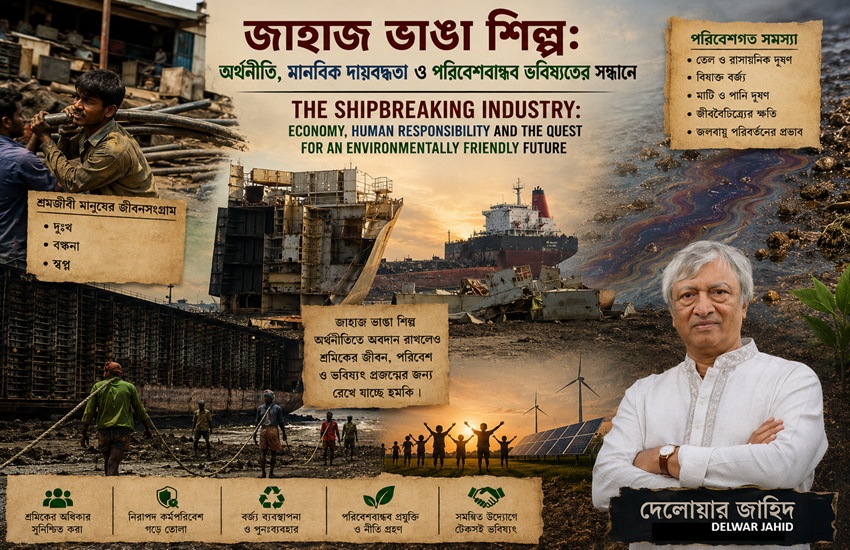
The Shipbreaking Industry: Economy, Human Responsibility, and the Search for an Environmentally Friendly Future
By Delwar Jahid
During a visit to Bangladesh’s first Hong Kong Convention-compliant green shipyard, PHP Ship Breaking and Recycling Industries, located in Sitakunda, Chattogram, German Ambassador to Bangladesh Dr. Rüdiger Lotz described the country’s shipbreaking industry as a highly promising sector. In his observation, despite various global challenges, the industry continues to make significant contributions to Bangladesh’s economy, employment generation, and industrial development. At the same time, he emphasized the importance of worker safety, environmental protection, and compliance with international standards.
The German Ambassador’s remarks not only indicate economic potential; they also raise profound humanitarian and ethical questions before us. In my childhood, the autobiographical works and literature of Russian writer Maxim Gorky deeply moved me. Gorky’s writings portrayed the struggles, suffering, deprivation, and dreams of working-class people with remarkable humanity, a reality that remains equally relevant today. He believed that the true power of literature emerges from real human life. Therefore, giving voice to neglected and hardworking people is not merely a literary duty but also a social responsibility. The lives, risks, struggles, and dreams of workers in Bangladesh’s shipbreaking industry are also part of this broader human reality.
The shipbreaking industry, or ship recycling industry, is an important sector of the global maritime economy. By dismantling old and obsolete ships and recovering steel, machinery, and recyclable materials, the industry supports construction and manufacturing sectors worldwide. Although the practice of reusing damaged ships dates back to ancient times, modern industrial shipbreaking began in the late nineteenth century with the rise of steel-based shipbuilding industries. During the first half of the twentieth century, industrialized countries such as the United States, the United Kingdom, Germany, and Japan led the sector. After the Second World War, vast numbers of military and commercial ships were dismantled to collect steel needed for reconstruction and industrialization.
Later, during the 1960s and 1970s, due to high labor costs, strict environmental regulations, and the availability of cheap labor in developing countries, the shipbreaking industry gradually shifted from the Western world to Asia. Taiwan and South Korea initially emerged as important centers, followed later by Bangladesh, India, and Pakistan, which became major hubs of the industry. Long coastlines, low operating costs, and domestic demand for scrap steel helped these countries establish strong positions in the global ship recycling sector.
In Bangladesh, the industry began in the 1960s with the dismantling of a Greek ship in Sitakunda, Chattogram. Today, the sector supplies a significant portion of the country’s steel demand and provides employment to thousands of people. India’s Alang and Pakistan’s Gadani shipyards are also globally recognized. However, alongside its economic importance, the industry has long been criticized for environmental pollution, hazardous waste, and unsafe working conditions. Asbestos, heavy metals, and toxic chemicals present in old ships create severe risks for workers and coastal ecosystems.
In this context, the International Maritime Organization adopted the Hong Kong Convention in 2009, aiming to ensure safe and environmentally sound ship recycling. At present, South Asian countries, including Bangladesh, are working to implement international standards, adopt modern technologies, establish green shipyards, and ensure worker welfare. Mohammad Zahirul Islam, Managing Director of PHP Ship Breaking and Recycling Industries, stated that the company has already invested more than 14 million US dollars in developing modern safety systems and environmentally friendly infrastructure. This demonstrates that the industry is gradually moving toward sustainable development and humanitarian responsibility.
Globally, the increasing number of aging ships, growing demand for recycling, and technological modernization are expected to further brighten the future prospects of the shipbreaking industry. The use of automated technologies, artificial intelligence, robotics, and environmentally controlled dry-dock systems could make the industry safer and more efficient. However, alongside economic growth and industrialization, equal importance must be given to workers’ lives, health, fair wages, and environmental protection. Because the true success of any industry lies not merely in profit, but in ensuring human dignity and safety.
Courtesy Ad-Condo Sale Listing- #204 91 Cosgrove Crescent, Red Deer
- Details
Condo Sale Listing- #204 91 Cosgrove Crescent, Red Deer
$165,000.00 New Listing
MLS®#:A2201486
Beds 2 Total Bath 1 Sq ft 764 Year Built 1982 Style Apartment-Single Level Unit
2 BEDROOM, 1 BATH CONDO ~ MOVE IN READY ~ COVERED BALCONY OVERLOOKING A PARK ~
Link to visit:
https://matrix.pillarnine.com/Matrix/Public/Portal.aspx?p=DE-250606699-230&k=200736X2bX3&eml=YW1hbmRhQGxpbWVncmVlbnJlYWx0eS5jYQ==
Courtesy:
Amanda Blake, Realtor
This email address is being protected from spambots. You need JavaScript enabled to view it.
- Additional Resources:
- Additional Resources:
- Agro-Ocean
- Bangabandhu Development and Research Institute
- Bangladesh North American Journalists Network
- Bangladesh Heritage and Ethnic Society of Alberta (BHESA)
- Coastal 19
- Delwar Jahid's Biography
- Diverse Edmonton
- Doinik Ekattorer Chetona
- Dr. Anwar Zahid
- Edmonton Oaths
- Mahinur Jahid Memorial Foundation (MJMF)
- Motherlanguage Day in Canada
- Samajkantha News
- Step to Humanity Bangladesh
