Requirements not met
Your browser does not meet the minimum requirements of this website. Though you can continue browsing, some features may not be available to you.
Browser unsupported
Please note that our site has been optimized for a modern browser environment. You are using »an unsupported or outdated software«. We recommend that you perform a free upgrade to any of the following alternatives:
Using a browser that does not meet the minimum requirements for this site will likely cause portions of the site not to function properly.
Your browser either has JavaScript turned off or does not support JavaScript.
If you are unsure how to enable JavaScript in your browser, please visit wikiHow's »How to Turn on Javascript in Internet Browsers«.
Select Language / ভাষা নির্বাচন:







Country News
Nation celebrates Pahela Baishakh amid festivity
- Details
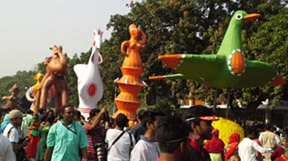
DHAKA, April 15, 2017 (BSS) - Thousands of people thronged the streets and different popular places in the capital and elsewhere across the country as the nation yesterday celebrated its most colourful and traditional festival Pahela Baishakh to welcome the Bangla New Year 1424.
Cultural and musical groups started off the first day of the Bangla year with songs and other performances at city parks while students of the Institute of Fine Arts of Dhaka University and youngsters brought out a "Mongol Shobhajatra" (procession of good wishes) in the morning as part of the carnival.
The day broke with the chirping of birds as usual, but the singing of "Esho hey Baishakh esho esho" everywhere in Bangladesh gave the day really a festive dimension.
Men in traditional pajamas and 'punjabi' and women in white and red saris joined the celebrations along with children in colourful attires, streaming through Dhaka streets as the first light of the sun rang in Bangla New Year.
National dailies have brought out colourful supplements while state-run Bangladesh Television and Bangladesh Betar and private TV channels and radio stations aired special programmes to mark the occasion. Festive mood gripped all major cities and towns with different programmes of cultural groups.
Ramna Batamul appeared as the main attraction of the New Year celebrations as "Chhayanaut" and other cultural groups have been staging traditional functions since morning.
The day was a public holiday.
President Abdul Hamid and Prime Minister Sheikh Hasina in separate messages greeted the countrymen on the occasion of Pahela Baishakh.
They wished peace, happiness and prosperity of the people and the country in the New Year.
The traditional Mangol Shovajartas (processions of good wishes) were also brought out at divisional, district and upazila levels to reach the traditional programme to grassroots as it earned the UNESCO recognition.
However, business communities, especially in the rural areas opened their traditional 'Halkhata', new account books to mark the day.
Important buildings and establishments as well as city streets and islands were illuminated with colourful lights and graffiti were painted in the walls signifying the arts, culture and heritage of the country.
Sammilita Sangskritik Jote organised solo and chorus folk music, dance and recitation of poems at Mirpur, Dania, Rayerbazar and different places in the capital city in the afternoon.
Bangla Academy staged cultural function and solo lecture at Rabindra-Chattar on the premises of the academy since 7.30am while a 10-day book-fair titled "Boier Arang" began marking the festival.
Besides, Bangladesh Small and Cottage Industries Corporation and Bangla Academy organizesd a 10-day Baishakhi Fair on the academy premises.
Dhakeswai National Temple also organized fair while Jatiya Press Club arranged a variety of traditional food items for the members and their family on the club premises. Dhaka Reporters' Unity also arranged identical programme.
Intensified security measure was ensured across the country including capital Dhaka to avert any untoward incident on Pahela Baishakh celebration.
Ramna Park and Suhrawardi Udyan areas have been taken under complete CCTV surveillance while Police in uniform and in undercover were deployed in and around the function arenas including Ramna Park. Visitors entered the venue through archways and metal detector checking, witnesses said.
Watchtowers have been installed in all the important places to monitor the movement of people while DMP also supplied pure drinking water to citizens and organized blood donation camp.
The local administrations arranged procession, cultural functions, village fairs and discussions at the divisional, district and upazilla levels on the occasion.
Improved diets of Banglee food was distributed among the inmates of jails, hospitals and orphanages in the capital and elsewhere across the country.
Cultural functions were also arranged at jails and orphanages across the country.
Bangladesh National Museum, Bangladesh Folk and Craft Arts Foundation, and archaeological sites under Department of Archaeology remained open for children, students and persons with disabilities to visit free of cost.
All educational institutions of the country including Rajshahi, Chittagong and Jahangirnagar universities also celebrated the day separately with enthusiasm and traditional gaiety.
Reports reaching here said Pahela Baishakh was also celebrated in Chittagong, Khulna, Rajshahi, Sylhet, Barisal, Jhalokathi, Rangpur, Faridpur, Madaripur, Gopalganj, Shariatpur, Mymensingh, Habiganj, Magura, Narayanganj, Munshiganj, Rangamati, Bagerhat, Kurigram, Kushtia, Joypurhat, Panchagarh, Khagrachhari, Laxmipur, Moulvibazar, Natore, Narail, Shariatpur and other districts amid huge enthusiasm.
According to historical records, celebrations of Pahela Baishakh, the first day of the Bangla Calendar Year, started from Emperor Akbar's reign when it was customary to clear all dues on the last day of the Bengali month of Chaitra with businessmen opening "halkhata" or new book of accounts in their shops.
In line with the tradition, the rural Bangladesh, with people thoroughly scrubbing and cleaning the homes, bathing early in the morning and dressing in fine clothes, rises with a new hope on this day.
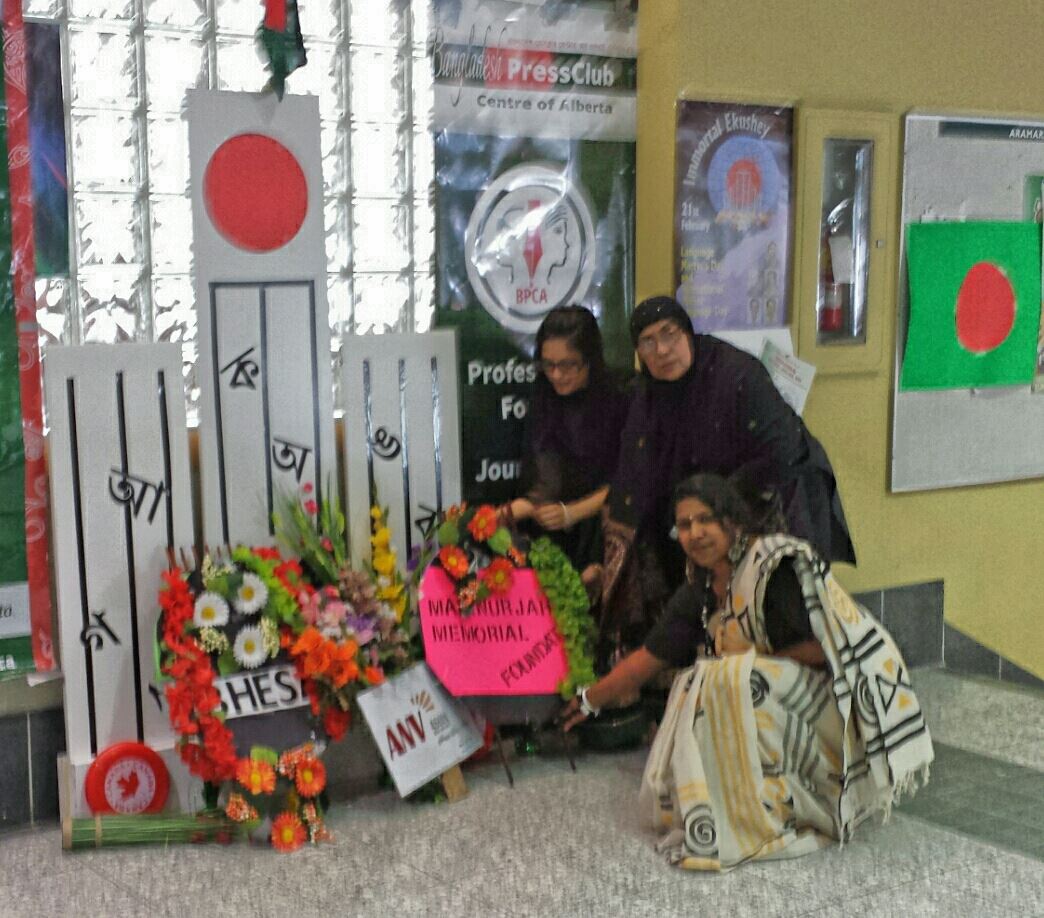
International Mother Language Day Celebration 2015
- Details
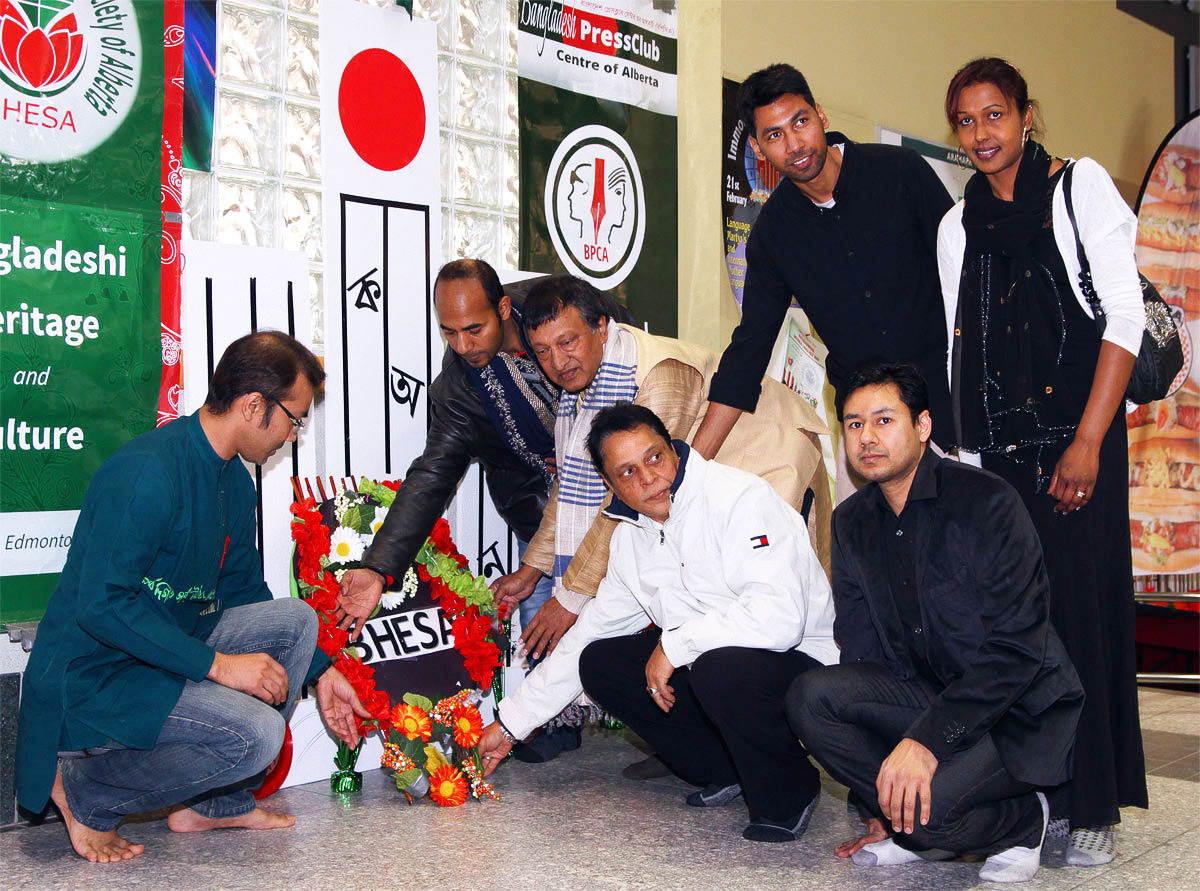
On February 21, 2015 numerous organizations, professional bodies, and people interested in the celebration of mother language and the topic of linguistic diversity joined together at the monument initiated by the Bangladesh PressClub Centre of Alberta (BPCA) in assistance with the Bangladesh Heritage and Ethnic Society of Alberta (BHESA).
The program was held at the premises of the Students' Association of the Grant MacEwan University in Edmonton. The program oficially started at 12.00 pm with a floral tribute to the language martyrs of Bangladesh, who left their lives for the recognition of their mother language Bangla. The event is considered as the inspiration behind International Mother Language Day on February 21st.
Amoung others the president of BHESA Delwar Jahid, Tomal Islam, Ahsan Ullah, Masud Bhuiyan, Anamur Rahman, Dollin Islam and Mezbaul Islam paid their respect to the martyrs of the language movement. Language veteran Mohammad Siddique Hussain, as well as Hafizur-Rahman, Dr. Mushfiqur Rahman, Tajul Ali (former president of BHESA), Mohd. Zakaria and others joined in.
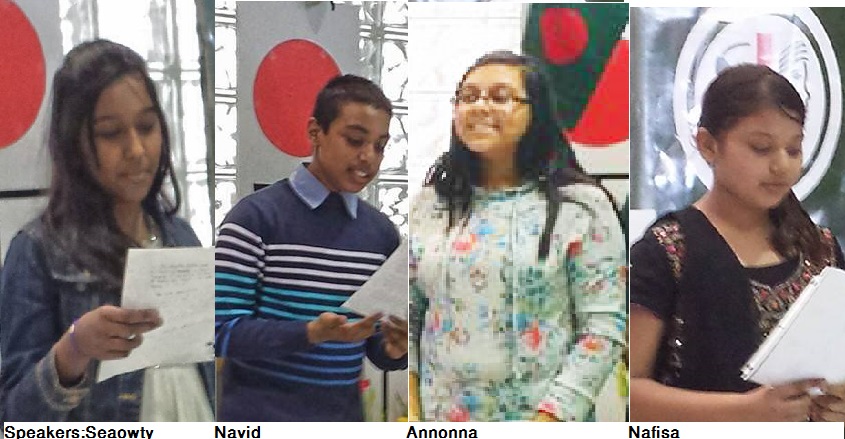
As principal partner of the program the Bangladesh Heritage and Ethnic Society of Alberta (BHESA) organized a children's drawing competition and a general discussion about the topic. The paintings of Borno, Shukurnnya, Shaharin, Rahat, Choudhury, Nafisa, and others were honored with a prize. The following discussion was attended by chief guest Mohd. Siddique Hossain and the guests of honor Dr. Nurul Islam, Dr. Hafizur Rahman, Dr. Mushfiqur Rahman, and Mezbaul Islam, presided over by Delwar Jahid. Among others Seaowty Choudhury, Navid Mirza, Roudashi Chowdhury and Nafisa Mirza spoke on the occasion.
In his speech Mohammad Siddiq Hussain recalled the Language Movement of 1952 and his own participation in it. President of BHESA, Delwar Jahid reminded the guardians of all children about the importance to exercise the mother tongue at home, while appreciating the paintings and participation of the children.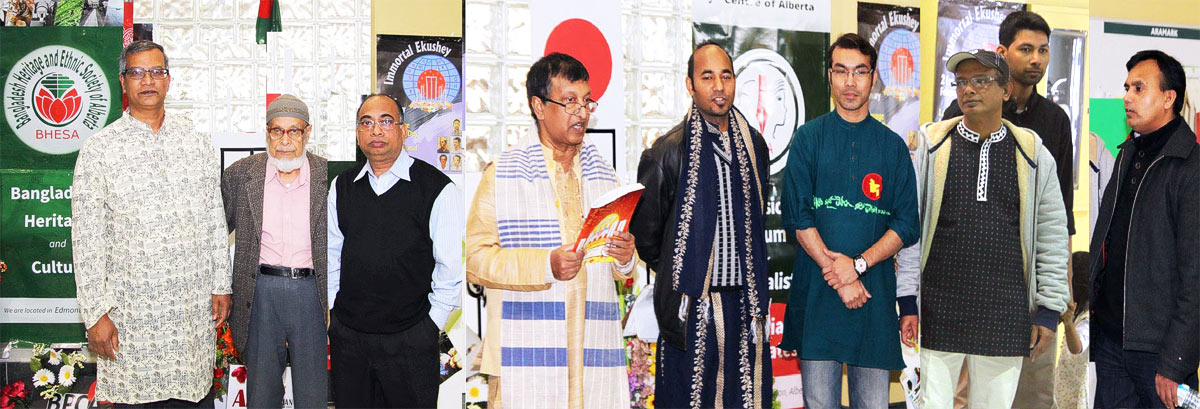
BHESA then announced the nominees of its 2015 Ekushey Heritage Awards, who are: Kausar Khondokar (University of MacEwan), Noor Alam (Bangla Bazar), Mohammad Zakaria (former executive of BHESA), and Dr. Moshfiqur Rahman (Univercity of Alberta). The Mahinur Jahid Memorial Foundation (MJMF) followed with its nomination for the Ekushey Youth Awards 2015. Nominated are Sheikh Jalil, journalist and writer (for literature and journalism) and Ahsan Ullah, the former general sectretary of BHESA (for voluntary activities and sports event organization).
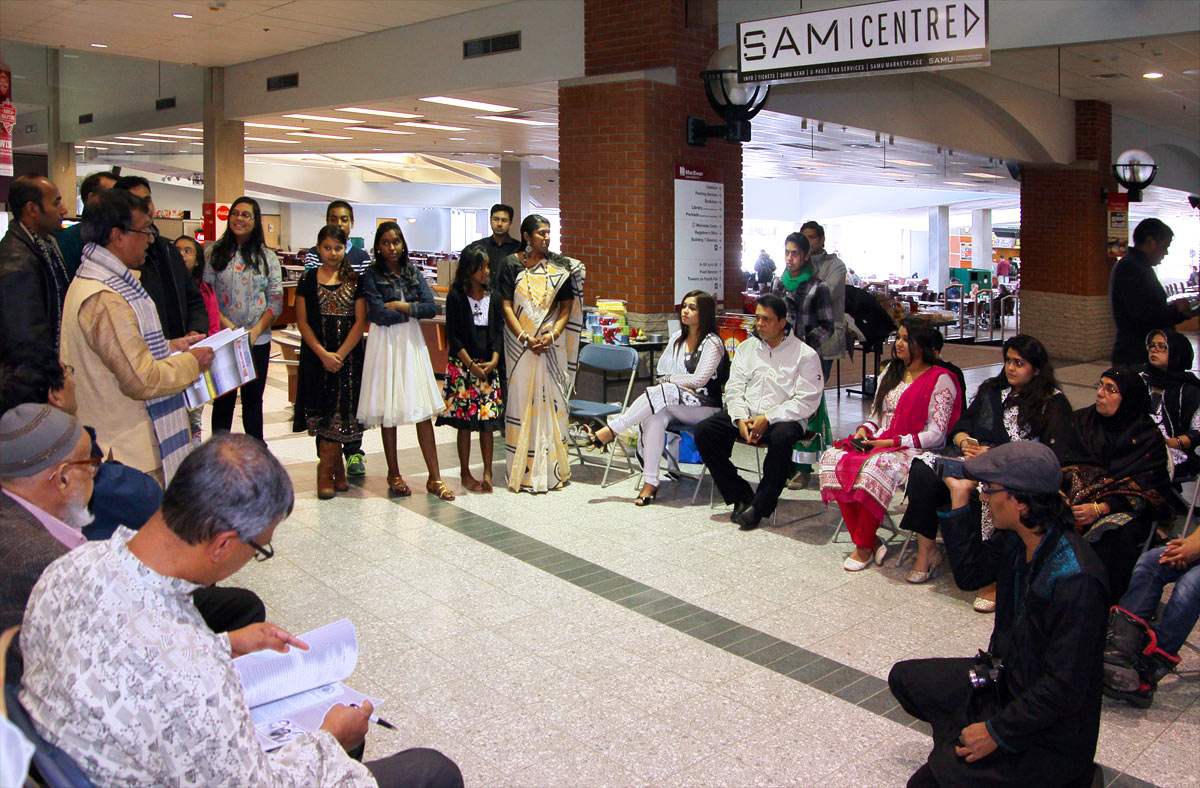
Asian News and Views organized foods and light entertainment. BPCA prepared a publication, the International Mother Language Day Magazine, Edition 2015, which has been distributed during the occasion and to connected communities.
- Additional Resources:
- Additional Resources:
- Agro-Ocean
- Bangabandhu Development and Research Institute
- Bangladesh North American Journalists Network
- Bangladesh Heritage and Ethnic Society of Alberta (BHESA)
- Coastal 19
- Delwar Jahid's Biography
- Diverse Edmonton
- Doinik Ekattorer Chetona
- Dr. Anwar Zahid
- Edmonton Oaths
- Mahinur Jahid Memorial Foundation (MJMF)
- Motherlanguage Day in Canada
- Samajkantha News
- Step to Humanity Bangladesh
